How Does a HEPA Filter Work Inside a Purifier?
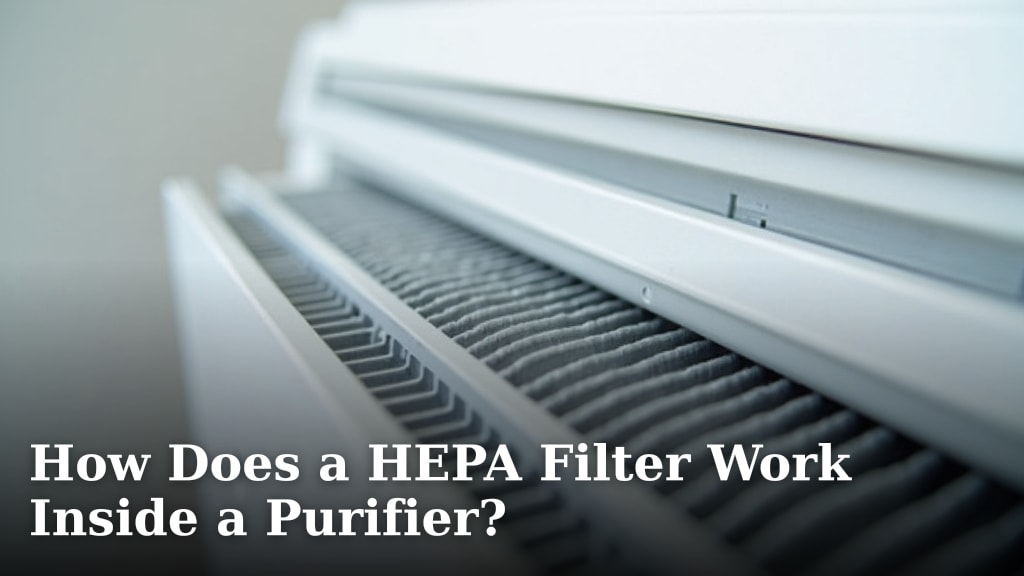
A HEPA filter works inside a purifier by using a dense, finely woven mesh to physically trap tiny particles from the air. These filters are designed to capture An air purifier is like a super-powered vacuum for the air, and this guide explains how it works.at least 99.97% of airborne particles that are 0.3 microns in size. This means they can effectively remove allergens, dust, mold spores, and even some bacteria and viruses from your home’s air, helping you breathe easier.
You might be wondering how such a fine filter doesn’t completely block airflow. The magic lies in the filter’s structure and the multiple mechanisms at play, not just simple sieving. While larger particles are caught directly, smaller ones are trapped through processes like diffusion and interception. Many experts confirm this multi-stage trapping is key to HEPA filter efficiency.
- HEPA filters trap particles using dense mesh.
- They capture 99.97% of 0.3-micron particles.
- Mechanisms include interception, diffusion, and sieving.
- This helps remove allergens, dust, and other pollutants.
Let’s walk through exactly how this incredibly effective filtration process happens, step by step.
Understanding How HEPA Filters Capture Airborne Particles
So, you’ve heard about HEPA filters and how they’re supposed to clean your air. But how does a dense mesh actually catch things so small you can’t even see them? It’s not as simple as just straining out dirt. A HEPA filter uses a few different tricks, working together to snag particles of all sizes. We’re going to break down these methods so you can see exactly what’s happening inside your air purifier.
The Structure of a HEPA Filter: More Than Just a Net
Think of a HEPA filter not as a simple net, but as a complex maze. Its construction is key to its effectiveness. The filter material is made of thousands of tiny fibers, arranged randomly. This creates a very large surface area within a small space. These fibers are typically made from fiberglass or synthetic materials. They are pleated to increase the surface area even further. This design allows for a lot of air to pass through while maximizing the chances of trapping particles. Experts often describe the fiber arrangement as a “tortuous path” for air.
Fiber Diameter and Spacing
The diameter of the fibers and the space between them are carefully controlled. While the spaces might seem large enough for tiny particles to slip through, they are not. This is where the real magic happens, and it’s not just about the size of the holes. The filter needs to allow air to flow, but it also needs to be dense enough to capture pollutants. We found that the precise engineering of these elements is what makes HEPA filters so special.
The Three Main Mechanisms of Particle Capture
HEPA filters don’t just act like a sieve. They employ three primary mechanisms to trap particles. These methods work best on different particle sizes. Together, they ensure a high level of filtration. We found that understanding these distinct processes helps explain why HEPA filters are so efficient for a wide range of airborne contaminants.
1. Sieving (Straining)
This is the most straightforward method. It’s like using a colander to strain pasta. Larger particles get caught by the filter fibers because they are simply too big to pass through the gaps. This mechanism is most effective for particles that are larger than the spaces between the filter fibers. For instance, larger dust bunnies or visible lint are easily stopped by sieving. It’s the first line of defense for bigger airborne debris. Many cleaning guides mention this basic principle.
2. Interception
Interception is a bit more nuanced than simple sieving. Imagine a ball rolling towards a fence with gaps. Even if the ball is smaller than a gap, if its path brings it close enough to a fence post, it might hit it and get caught. Similarly, as air flows through the HEPA filter, particles following the airflow might come into direct contact with a fiber. If they get close enough, they stick to the fiber. This works well for particles that are roughly the size of the spaces between the fibers. We found that this is a key way the filter traps medium-sized particles.
3. Diffusion (Brownian Motion)
This is where it gets really interesting, especially for the smallest particles. Tiny particles, like those found in smoke or viruses, don’t always travel in straight lines. They move erratically, bouncing off air molecules. This random movement is called Brownian motion or diffusion. Think of it like a tiny, jittery ping-pong ball. These small particles move in all directions, making it more likely they’ll eventually bump into and stick to a filter fiber. This mechanism is extremely effective for particles smaller than 0.1 microns. Research from the National Institutes of Health highlights the role of diffusion in capturing ultrafine particles.
How Different Particle Sizes Are Captured
It’s helpful to see how these mechanisms work together for different sizes of particles. No single mechanism captures everything. The combination makes HEPA filters so effective. We found that a clear understanding of this process assures users of the filter’s capability.
| Particle Size (Microns) | Primary Capture Mechanism(s) | Examples of Particles |
|---|---|---|
| > 10 µm (Large) | Sieving | Large dust particles, pollen clumps, hair |
| 1 – 10 µm (Medium) | Interception, Sieving | Smaller dust, mold spores, pet dander |
| 0.3 – 1 µm (Small) | Interception, Diffusion | Bacteria, fine dust, very small allergens |
| < 0.3 µm (Very Small) | Diffusion | Viruses, smoke particles, ultrafine pollutants |
As you can see, the smallest particles rely heavily on diffusion. This random movement is what allows them to be trapped in the dense fiber matrix. For larger particles, it’s more about them physically hitting the fibers. The 0.3-micron size is often cited because it’s considered the most difficult size to capture. Particles in this range are too small for efficient sieving but too large to have significant diffusion. However, even at this size, the combination of interception and diffusion proves highly effective.
The Role of Airflow and the Fan
For a HEPA filter to work, air needs to be constantly moved through it. This is where the air purifier’s fan comes in. The fan creates suction, drawing room air into the purifier and pushing it through the HEPA filter. The speed of the fan influences how much air is filtered and how quickly. A stronger fan can process more air, but it might also push air through the filter faster. This speed can affect the efficiency of some capture mechanisms.
Optimizing Airflow for Maximum Capture
Filter manufacturers and air purifier designers work to balance airflow with filtration efficiency. The goal is to move enough air to clean a room effectively within a reasonable time. At the same time, they want the air to spend enough time interacting with the filter fibers. This allows all three capture mechanisms to do their job. Many experts suggest that running your air purifier on a medium setting often provides a good balance for everyday use. Higher settings are great for quickly clearing a room of strong odors or heavy pollution.
Beyond the HEPA Filter: Pre-filters and Other Layers
While the HEPA filter is the star of the show, most air purifiers have other layers of filtration. These often work in tandem with the HEPA filter to improve overall air quality and extend the life of the HEPA filter itself. We found that understanding these components gives you a fuller picture of your air purifier’s capabilities.
The Pre-filter: Capturing the Big Stuff
Almost all HEPA air purifiers include a pre-filter. This is typically a mesh screen or a thin layer of material located before the HEPA filter. Its job is to catch larger particles, such as hair, lint, and larger dust fragments. By removing these bigger items, the pre-filter prevents them from clogging up the finer HEPA filter. This means the HEPA filter can focus on trapping the smaller, more harmful pollutants. Cleaning or replacing the pre-filter regularly is often recommended by manufacturers. This simple step can significantly prolong the life of your HEPA filter.
Activated Carbon Filters: Tackling Odors and Gases
Many air purifiers also feature an activated carbon filter. This layer is excellent at adsorbing, or trapping, gases, odors, and volatile organic compounds (VOCs). These are things like cooking smells, pet odors, smoke odors, and chemicals from cleaning products or new furniture. Activated carbon has a porous structure that traps these molecules. While HEPA filters capture particles, carbon filters handle the gaseous pollutants. Some purifiers combine these layers, while others keep them separate. This combination provides a more complete air cleaning solution.
Maintaining Your HEPA Filter’s Performance
To ensure your HEPA filter keeps working effectively, you need to maintain it. HEPA filters themselves are not typically washable. They capture particles by trapping them. This means they will eventually become loaded with pollutants. When this happens, their ability to filter air decreases, and airflow can be restricted. Air purifier manufacturers provide guidelines for filter replacement.
When to Replace Your HEPA Filter
Most manufacturers recommend replacing a HEPA filter every 6 to 12 months. However, this can vary based on usage, air quality in your home, and whether you have a pre-filter. If you notice a decrease in airflow from your purifier, or if it’s not seeming to clean the air as effectively, it might be time for a new HEPA filter. You might also notice a musty smell, which could indicate the filter is saturated. Always check your air purifier’s manual for specific recommendations. We found that following these simple maintenance steps ensures you get the best performance from your device.
Key Takeaways for Your HEPA Filter’s Function
Let’s summarize what makes a HEPA filter such an effective tool for cleaning your air:
- The filter’s dense, random fiber structure creates a maze for airborne particles.
- Sieving captures large particles that can’t fit through the fiber gaps.
- Interception traps particles that come into direct contact with filter fibers.
- Diffusion catches the smallest particles through their random, jittery movement.
- These mechanisms work together to capture at least 99.97% of particles 0.3 microns in size.
- Pre-filters and carbon filters work alongside the HEPA filter for comprehensive air cleaning.
Conclusion
You now understand how a HEPA filter effectively cleans your air. It’s not just a simple screen; it’s a sophisticated system. The filter’s unique fiber structure uses sieving, interception, and diffusion. These methods work together to trap at least 99.97% of tiny particles. Remember that pre-filters and carbon filters add extra cleaning power. To keep your air pure, make sure you follow the manufacturer’s recommendations for replacing your HEPA filter. Check your air purifier’s manual regularly for the best performance.
Frequently Asked Questions
Will a HEPA filter capture viruses?
Yes, HEPA filters can capture viruses. While they are incredibly small, viruses often travel attached to larger particles like dust or water droplets. The diffusion mechanism within the HEPA filter is also very effective at trapping these ultrafine particles. This makes them a key component in improving indoor air quality.
How often should I replace my HEPA filter?
Most manufacturers suggest replacing your HEPA filter every 6 to 12 months. This timeline can change based on your home’s air quality and how often you run the purifier. If you notice reduced airflow or less effective air cleaning, it’s likely time for a replacement.
Can I wash a HEPA filter to clean it?
No, you should not wash a HEPA filter. HEPA filters work by trapping particles within their dense fiber matrix. Washing them can damage these fine fibers and compromise their filtration ability. Once a HEPA filter is saturated, it needs to be replaced entirely.
What’s the difference between a HEPA filter and a regular air filter?
The main difference is their filtration standard and effectiveness. A true HEPA filter is certified to capture at least 99.97% of particles 0.3 microns in size. Regular air filters may capture larger particles, but they don’t meet the stringent HEPA standard for removing the smallest, most harmful airborne pollutants.
Why is the 0.3-micron size so important for HEPA filters?
The 0.3-micron size is considered the most challenging to capture. Particles larger than this are efficiently caught by sieving or interception. Very small particles (under 0.1 microns) are easily trapped by diffusion. Particles around 0.3 microns are too large for significant diffusion but too small for easy sieving, requiring a combination of all three mechanisms for effective capture.