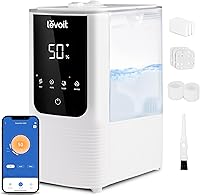
Humidifiers: The Complete Buying Guide
Choose a humidifier that matches the room, mist type and cleaning routine. Portable models suit one room, while a whole house system connects to your HVAC; use a hygrometer to guide output and avoid excess moisture.
On this page (13 sections)
- Which type of humidifier is best?
- How do you choose a humidifier for room size?
- Should you buy a portable or whole house humidifier?
- What should you check before choosing cool mist or warm mist?
- Which humidifier features are useful?
- How quiet should a bedroom humidifier be?
- How do you keep a humidifier clean?
- How do you choose a humidifier for children, plants or special spaces?
- How do you fill and set up a humidifier?
- How do humidifiers fit into home ventilation?
- What should you compare before buying a humidifier?
- Explore humidifiers by topic
- Which humidifier should you choose?
A humidifier adds moisture to indoor air when the air is too dry. Choose by the space you want to humidify, how much cleaning you can manage, and whether you need a portable unit or a whole house system.
Use a hygrometer to check the room before buying. Too much moisture can cause condensation and damp surfaces, so aim for a comfortable level without letting windows, walls or furnishings stay wet.
This guide compares humidifier types, room sizing, controls, cleaning and upkeep. If you want a shortlist first, see our best humidifiers for home.
Which type of humidifier is best?
The best humidifier type depends on how it adds moisture and how you plan to maintain it. Portable ultrasonic and evaporative models are common for individual rooms; whole house systems connect to home HVAC equipment.
| Type | How it adds moisture | Consider it if | Check before buying |
|---|---|---|---|
| Ultrasonic | Vibrations create a cool mist | You want a compact unit with few moving parts | Cleaning, water quality and whether it uses a filter |
| Evaporative | A fan moves air through a wet wick or pad | You prefer moisture to evaporate from a wick | Fan noise and replacement wick or pad costs |
| Warm mist | Heats water to release vapor | You want a heated mist style | Hot water and burn risks, plus cleaning needs |
| Whole house | Adds moisture through HVAC equipment | You want coverage beyond one room | HVAC compatibility, installation and maintenance |
These are broad design differences, not guarantees of performance. Model capacity, room layout and maintenance all affect how well a unit fits your home.
For a direct comparison of technologies, read cool mist vs warm mist humidifiers. If you are weighing a steam vaporizer against other options, our humidifier vs vaporizer guide explains the practical differences.
How do you choose a humidifier for room size?
Match a portable humidifier's stated coverage to the room where you will use it, then consider ceiling height, open doorways and how the room connects to nearby spaces. A larger tank can reduce refill frequency, but it does not guarantee that the unit can manage a larger area.
Room coverage figures vary by model and conditions. Treat them as a starting point, then check humidity with a hygrometer after you set up the unit.
| Your space | What to compare |
|---|---|
| Small bedroom or office | Compact footprint, tank access and easy cleaning |
| Bedroom or nursery | Noise, display lights, controls and safe placement |
| Large open room | Stated coverage, output control and refill routine |
| Several rooms | Whole house system or separate portable units |
Do not assume that one portable unit will humidify an entire floor through open doors. Airflow, room separation and the location of the unit can change how moisture spreads.
For targeted options, compare small room humidifiers, bedroom humidifiers and large room humidifiers.
What capacity should you look for in a humidifier?
Tank capacity affects how often you refill, not the size of the room a unit can handle by itself. Look at the manufacturer's coverage guidance and output controls alongside tank size.
A 3.5 L tank is one example of a portable size. The MEGAWISE 3.5L Cool Mist Humidifier has adjustable mist, a top-fill design, a night light and auto shut-off.
A larger tank can be heavier to carry when full, so consider where you will fill it and whether the tank lifts off the base. For help with setup, see how to fill a humidifier.
Should you buy a portable or whole house humidifier?
Choose a portable humidifier for one room and consider a whole house model when you want humidity control across multiple rooms through compatible HVAC equipment. The right choice depends on your home, installation options and willingness to maintain the system.
A portable unit is easier to move and does not require HVAC installation. It does need regular filling, cleaning and a suitable surface with room for airflow.
A whole house system can serve more than one room, but it relies on HVAC compatibility and routine upkeep. Some systems use a pad that needs replacement; the Honeywell Home HC26P Whole House Humidifier Pad is compatible with specified Honeywell Home humidifier models.
If you are considering broader coverage, compare best whole house humidifiers. For the larger decision of whether a whole house unit suits you, weigh installation and upkeep against the convenience of treating several rooms.
Do you need a whole house humidifier?
A whole house humidifier may make sense if several rooms need added moisture and your HVAC system can support the equipment. If one bedroom or office is the only concern, a portable unit is usually the more direct option.
Before buying, confirm that your furnace or air handler is compatible and identify who will install and service the system. Check how the humidifier is controlled, how often its pad or other parts need replacement, and whether your home has a way to measure humidity.
Choose a portable model if you want to adjust one room independently or avoid tying the decision to HVAC equipment. You can also compare humidification with moisture removal in our humidifier vs dehumidifier guide.
What should you check before choosing cool mist or warm mist?
Cool mist and warm mist models differ in how they produce moisture and the safety concerns around them. Cool mist avoids heating water, while warm mist units heat water and need extra care around children, pets and anything that could tip them.
A cool mist model may be ultrasonic or evaporative. Ultrasonic units use vibrations to make mist, while evaporative units use a wick and fan.
Either way, follow the manual for cleaning and water use.
Warm mist models release vapor from heated water. Keep them on a stable surface out of reach, and do not place them where someone could spill hot water.
The MEGAWISE 3.5L is an ultrasonic cool mist option. The Homvana Cool Mist Humidifier is also ultrasonic and combines a 3.6 L tank with top filling, auto shut-off, a sleep mode and an aroma pad.
For more targeted comparisons, read about cool mist humidifiers, warm mist humidifiers and when to use a warm mist humidifier. The cool mist vaporizer vs humidifier comparison also clarifies terminology that brands sometimes use differently.
Which humidifier features are useful?
Useful features are the ones that solve a specific daily task, such as filling the tank, sleeping beside the unit or keeping mist pointed away from a wall. Check each feature against how you will actually use the humidifier.
- Top fill: can make filling easier if you do not want to carry a tank to a sink.
- Adjustable output: lets you change mist output as room conditions change.
- Auto shut-off: turns off the unit when its water runs out, if the model includes this feature.
- Humidistat: can help manage a target humidity level, but check how the model senses and controls moisture.
- Night mode: may turn off display lights or change operation; verify what the setting actually does.
- Aroma pad or tray: use only as the manufacturer directs. Do not add oils to a water tank unless the manual permits it.
- Filter or wick indicator: helps track replacement on models that use those parts.
A feature list does not replace basic fit checks. Confirm the unit's room coverage, cleaning steps and replacement parts before prioritizing lights or app controls.
If you want fragrance as well as moisture, compare humidifiers with essential oil diffusers. For a combined appliance, see air purifier and humidifier combos.
How quiet should a bedroom humidifier be?
For a bedroom, compare the manufacturer's noise claim, display controls and sleep mode, and place the unit where its mist will not wet bedding or a wall. Noise labels alone do not tell you how it will sound in your room.
The Homvana H101 advertises a SilentSpray feature and a display-off sleep mode. MEGAWISE advertises quiet operation and adjustable mist.
These features can help narrow your search, but your room and sensitivity to sound matter too.
Run the unit on a lower setting if its output allows it, and keep it on a stable surface. Our guide to which humidifier is the quietest compares options for sound-sensitive rooms.
How do you keep a humidifier clean?
Clean a humidifier on the schedule in its manual, because standing water and mineral deposits can collect in the tank and base. Empty unused water, dry parts as directed and use only cleaning methods approved by the manufacturer.
A simple routine helps you remember the work:
- Turn off and unplug the unit before cleaning.
- Empty the tank and base, following the manual's directions.
- Remove scale or residue with an approved cleaning method.
- Rinse and dry parts as instructed before filling again.
- Replace wicks, pads or filters at the maker's recommended interval.
Do not mix cleaning chemicals. Keep the unit away from materials that should stay dry, and stop using it if parts are damaged or the manual's instructions are unclear.
An easy-to-clean design matters if you expect frequent use. Compare easy-to-clean humidifiers and check whether the tank opening, base and removable pieces are reachable.
What water should you use in a humidifier?
Use the water type recommended in the humidifier's manual. Some models may call for distilled or demineralized water to limit mineral deposits, while others specify different care.
Tap water can leave mineral residue in some humidifiers, and ultrasonic models may disperse minerals into the room with the mist. If you see white dust or buildup, check the manual and water-treatment guidance before changing your routine.
Do not add water treatments, oils or other additives unless the manufacturer permits them. See humidifier water treatments for options and selection points.
When do humidifier filters need replacement?
Replace a wick, pad or filter at the interval and conditions the manufacturer specifies. For one model, see the Levoit Classic 300S replacement filter.
A used part may collect minerals and debris, and the replacement schedule can vary by model and water conditions.
Check your unit's exact model number before ordering parts. The Honeywell Home HC26P pad fits selected HE200, HE250, HE260, HE265, HE280, HE300, HE360 and HE365 models, and Honeywell recommends changing it twice a year.
For other parts, verify model compatibility before you buy. Browse humidifier replacement filters and ultrasonic humidifier parts.
How do you choose a humidifier for children, plants or special spaces?
Choose a unit for the room and its users, then place it where it cannot be knocked over or create wet surfaces. A humidifier can add moisture, but it does not replace appropriate care for children, plants or stored belongings.
For a child's room, focus on stable placement, simple cleaning and controls you can reach. Cool mist avoids the hot water used by warm mist units, but the tank and cord still need to be kept out of reach.
Compare humidifiers for kids rooms.
Plants vary in their humidity needs, so group plants with similar needs and measure the space rather than aiming mist directly at leaves. See humidifiers for indoor plants.
For a closet, cabinet or other small enclosed area that is too damp, adding humidity is the wrong direction. The Eva-Dry Wireless Mini Dehumidifier is a cordless silica gel moisture absorber designed for small spaces such as closets, cabinets and cars.
How do you fill and set up a humidifier?
Set up the humidifier on a level, water-resistant surface, away from walls, electronics and fabrics that should stay dry. Follow the manual for tank filling, placement and first use.
A top-fill model lets you add water from above, while other designs may require removing and turning over a tank. Avoid overfilling, and secure the tank as instructed before switching on the unit.
For step-by-step help, use our guides to filling a Honeywell humidifier and filling a humidifier. Keep the power cord away from wet areas, and do not operate a unit with a damaged cord or tank.
How do humidifiers fit into home ventilation?
A humidifier manages moisture; ventilation moves indoor air and can help remove moisture and odors. These tools serve different needs, so use ventilation when the issue is stale or damp air rather than low humidity.
Bathrooms are a common source of indoor moisture. A working exhaust fan can move humid air outdoors, but it needs a suitable duct route and outdoor termination.
Our bathroom exhaust fan guide covers fan selection, and how to vent a bathroom exhaust fan explains the duct path.
For ducted air movement beyond a bathroom, learn what an inline duct fan does. Avoid adding humidity to a space that already has condensation or damp surfaces.
What should you compare before buying a humidifier?
Compare room coverage, mist type, refill access, cleaning effort and ongoing parts before deciding. A unit is a better fit when its routine matches your space and schedule.
Use this checklist:
- Measure the room and note open doorways or connected spaces.
- Check the stated coverage and output controls.
- Decide whether cool mist, warm mist or an HVAC-connected system fits.
- Check tank access, capacity and how you will carry it to refill.
- Read the cleaning steps and replacement schedule.
- Confirm any filter, wick or pad is available for your model.
- Check controls and lights if the unit will run near a bed.
- Plan a stable location with clear airflow and surfaces that can stay dry.
A small portable unit may suit a bedroom, while a whole house system may be worth comparing if multiple rooms need attention and your HVAC can support it. Keep measuring conditions after setup and adjust the unit if you see condensation.
Explore humidifiers by topic
- Best Honeywell Humidifiers for Home
- Best Evaporative Humidifiers for Home
- Best Ultrasonic Humidifiers for Home
Which humidifier should you choose?
Choose a portable cool mist humidifier for one room, an evaporative model if its wick-based maintenance fits your routine, and a whole house system if you need broader coverage through compatible HVAC equipment. Compare cleaning and replacement needs before choosing based on convenience features.
If the space is already damp, use a dehumidifier or improve ventilation instead of adding moisture. If you are still narrowing options, start with best humidifiers for home, then compare the type and room-size guides that match your home.
Frequently asked questions
Which type of humidifier is best?
The best type depends on where you need humidity and how much care you want to provide. Ultrasonic models are often compact and quiet, evaporative models use a wick or pad, and whole house systems connect to HVAC equipment.
Compare cleaning steps, room coverage and replacement parts before buying.
Do I need a whole house humidifier?
A whole house humidifier may suit you if you want humidity managed across multiple rooms and have compatible HVAC equipment. A portable humidifier is simpler when only one room needs adjustment.
Check installation needs, maintenance, controls and your home's actual humidity before choosing a system.
Is cool mist or warm mist better?
Cool mist and warm mist models add moisture in different ways, so choose based on room use, cleaning needs and safety. Warm mist units heat water, which can pose a burn risk if tipped.
Cool mist units avoid that hot-water concern but still need regular cleaning.
How often should you clean a humidifier?
Follow the manufacturer's cleaning schedule and instructions, and empty and dry the tank when the unit is not in use. Mineral deposits and standing water can build up, so check the tank, base and any wick or filter regularly.
Use only cleaners the manual permits.
Can a humidifier and air purifier run in the same room?
Yes, they can run in the same room, but keep each device's intake and outlet clear and follow both manuals for placement. Moisture should not blow directly onto an air purifier or its filter.
A combo unit can save space, though separate devices offer more placement flexibility.
Can a humidifier help indoor plants?
A humidifier can raise moisture in the air around plants, but it does not replace watering or plant-specific care. Group plants with similar humidity needs, measure room conditions, and avoid keeping leaves or soil constantly wet.
Choose a unit sized for the room, not just the plant shelf.