9 Best Air Purifiers for Mold Spores (October 2026)
The best HEPA air purifiers for airborne mold spores include the Levoit Air Purifier for Home Pets Hair for a compact bedroom, the COWAY Airmega Mighty2 Air Purifier for larger shared rooms, and the GermGuardian HEPA Air Purifier Tower for small rooms and spores.
On this page (7 sections)
- The best air purifiers for mold spores
- How does a HEPA air purifier help with mold spores?
- What should you check before choosing a HEPA air purifier for mold?
- Can an air purifier remove mold from walls or furniture?
- Is an air purifier or dehumidifier better for mold?
- More guides on this topic
- Which air purifier should you choose for mold spores?
The best air purifier for mold spores is a HEPA model sized for the room, because HEPA filtration can capture airborne particles that pass through the filter. The COWAY Airmega Mighty2 is our top pick for its HEPA and active carbon system and high stated CADR, while the GermGuardian AC4300WPT directly names mold spores in its filter claim.
An air purifier can reduce airborne spores, but it won't remove mold growth from a surface or fix the dampness that supports it. Find and address leaks or condensation, then clean or remove affected materials with suitable safety steps.
If you're comparing a best air purifier for mold and dust pick, consider whether you need faster air circulation in a bedroom or simply filtration in a larger shared space. Room size and air changes per hour can matter as much as filter wording.
Our picks at a glance
-
1

-
2
-
3
 Best for small rooms and spores
GermGuardian HEPA Air Purifier Tower
9.5/10 our score
See it on Amazon
- 4
 Check it
PuroAir 240 HEPA Air Purifiers for Home
Best for quiet everyday use - 5
 Check it
GermGuardian Air Purifier for Homes with Pets
Best for stated mold-spore capture - 6
 Check it
KNKA Air Purifiers for Home Bedroom Up
Best for adjustable airflow - 7
 Check it
Clorox Medium Room Air Purifiers for Bedroom
Best for medium rooms with air feedback - 8
 Check it
AIRDOCTOR Air Purifier for Home
Best for fine-particle filtration - 9
 Check it
Air Oasis iAdaptAir 2.0 H13 HEPA Filter
Best for multi-stage filtration
The best air purifiers for mold spores
The best fit depends on the room's size, the purifier's airflow and whether the filter claim covers mold spores directly. We compared the stated filtration, CADR, coverage and useful controls for these nine models.
Levoit Air Purifier for Home Pets Hair: Best for a compact bedroom
- AHAM VERIFIDE
- 143 CFM CADR
- 99.97% filtration for 0.1 to 0.3 μm airborne particles
- 24 dB Sleep Mode
A quiet option for a bedroom where fine-particle filtration and verified CADR matter. Its stated coverage drops to one air change per hour in a 1,073 sq ft room.
Pros
- AHAM VERIFIDE
- Sleep Mode runs at 24 dB
- Filter efficiency stated for particles from 0.1 to 0.3 μm
Cons
- No mold-spore-specific capture figure is provided
- The 1,073 sq ft figure is one air change per hour
Levoit is a sensible bedroom pick if quiet operation and a clear room-size figure matter. Its filter is described as HEPA-grade in Sleep Mode, and Levoit reports 99.97% filtration efficiency for airborne particles from 0.1 to 0.3 μm.
The Core 300-P's AHAM VERIFIDE CADR is 143 CFM for smoke, 153 CFM for dust and 167 CFM for pollen. Levoit gives a faster circulation figure for 222 sq ft, while the 1,073 sq ft figure is one air change per hour.
That makes it easier to choose a practical room size than relying on a single maximum area number. For a bedroom, compare the 222 sq ft figure with your room and consider whether you'll run it at a setting you can tolerate overnight.
Levoit says Sleep Mode runs at 24 dB and lets you turn off the display lights. The provided particle claim covers pollen, dust and animal dander, but it doesn't give a specific mold-spore capture rate.
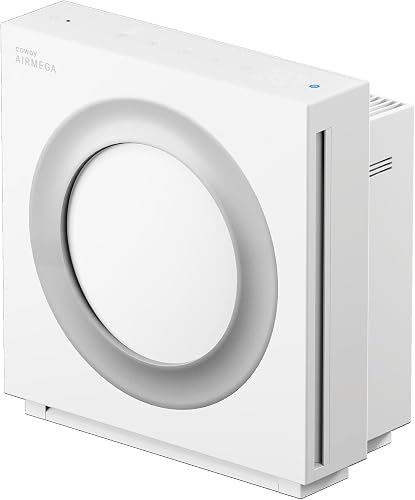
COWAY Airmega Mighty2 Air Purifier: Best for larger shared rooms
- HEPA and active carbon filter
- 242 CFM dust CADR
- Particle sensor with Smart Mode
- Washable pre-filter
A strong fit for a larger room where HEPA filtration, active carbon and airflow control are useful. The room coverage claims describe different cleaning times, so compare the faster 900 sq ft figure with your needs.
Pros
- High stated CADR values
- Smart Mode adjusts airflow to air quality
- Washable pre-filter and filter-life display
Cons
- No mold-spore-specific capture rate is stated
- Room coverage depends on the cleaning time
The COWAY Airmega Mighty2 is the strongest all-around choice here for larger rooms where you want high airflow and HEPA filtration. For another Coway model, read the AP-1512HH Mighty review.
Its 2-in-1 HEPA and active carbon filter sits behind a washable pre-filter.
COWAY states dust, smoke and pollen CADR values of 242, 240 and 249 CFM. It describes coverage as 900 sq ft in 30 minutes or 1,800 sq ft in 60 minutes, so match the faster figure to rooms where more frequent air cleaning is a priority.
A particle sensor reads PM1, PM2.5 and PM10, while Smart Mode adjusts airflow based on air quality. The filter-life display tracks both the washable pre-filter and the Max2 filter.
The maker states capture of airborne particles down to 0.3 μm, but does not give a mold-spore-specific rate. This is a strong general HEPA option when its airflow fits your space.
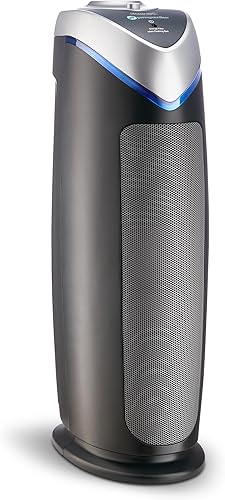
GermGuardian HEPA Air Purifier Tower: Best for small rooms and spores
- HEPA filter captures 99.97% of allergens as small as 0.1 μm
- Optional UV-C light
- Activated carbon filter
- Three fan speeds
The stated HEPA filter captures allergens down to 0.1 μm, and the small-room air circulation figure is useful for bedroom planning. GermGuardian does not provide a mold-spore-specific capture rate for this model.
Pros
- Small-room air circulation stated
- Optional UV-C light
- Activated carbon filter reduces some scents
Cons
- Coverage in 743 sq ft is once per hour
- No mold-spore-specific filtration figure
The GermGuardian AC4825E suits a small room where you want HEPA filtration and a straightforward tower shape. GermGuardian says its HEPA PURE filter captures 99.97% of allergens as small as 0.1 μm, including dust, pollen and pet dander.
It circulates air in a 153 sq ft room every 12.5 minutes. The larger 743 sq ft figure is one circulation per hour, which is a slower rate for a room that size.
The three-speed design includes a sleep mode, and an activated carbon filter reduces scents from cooking and pets. An optional UV-C light is also included as a feature, but the key selection point for spores is the HEPA filter and room airflow.
The AC4825E's stated claim doesn't name mold spores specifically. For a purifier whose stated HEPA claim does name them, compare the AC4300WPT below.
PuroAir 240 HEPA Air Purifiers for Home: Best for quiet everyday use
- Three-layer filtration
- HEPA and activated carbon
- Smart particle sensor
- Sleep mode
A straightforward choice for a room where a three-layer filter and automatic adjustment are priorities. Its stated coverage is one air change per hour in a room up to 1,000 sq ft.
Pros
- HEPA and carbon in a three-layer system
- Particle sensor adjusts power
- Sleep mode
Cons
- No mold-spore-specific capture rate is stated
- The largest coverage figure is based on one hour
PuroAir 240 combines a pre-filter, HEPA filter and activated carbon in a three-layer system. It is a reasonable pick if you want sensor-based automatic adjustment and a sleep mode.
PuroAir states coverage up to 1,000 sq ft in one hour. Treat that as a broad coverage figure rather than a promise of rapid particle reduction in every room, since layout, airflow and placement affect how often air reaches the filter.
The built-in particle sensor can increase power when it detects polluted air. The brand also describes the purifier as designed for continuous use, with sleep mode for quieter operation.
Its filtration claim names dust, pollen, smoke, pet dander and VOCs, but not mold spores directly. Consider it for general particle filtering where its room coverage and controls suit your routine.
GermGuardian Air Purifier for Homes with Pets: Best for stated mold-spore capture
- Pet Pure HEPA filter
- Captures up to 99.97% of mold spores and other allergens as small as 0.1 μm
- Optional UV-C light
- Activated charcoal filter
This GermGuardian model directly names mold spores in its filter claim, making it the clearest match if that detail guides your choice. Its faster stated air circulation applies to a 153 sq ft room.
Pros
- Mold spores included in the stated HEPA capture claim
- Optional UV-C light
- Activated charcoal helps reduce odors
Cons
- 743 sq ft coverage is one air change per hour
- No room-specific mold result is given
The GermGuardian AC4300WPT is the clearest match for readers seeking a HEPA air purifier for mold, because its Pet Pure filter claim specifically includes mold spores. GermGuardian states capture up to 99.97% of mold spores and other allergens as small as 0.1 μm.
For a small room, it circulates air in 153 sq ft 4.8 times per hour. Its 743 sq ft coverage is one air change per hour, so choose according to the smaller, more frequent-circulation figure when possible.
The unit includes a pre-filter for larger particles and an activated charcoal layer to help reduce odors. It also has an optional UV-C light, but that feature does not replace the need to control moisture or remove mold growth.
This model stands out because the claim names spores, not because a purifier can solve an active mold problem. Pair it with cleaning and moisture control if mold is growing indoors.
KNKA Air Purifiers for Home Bedroom Up: Best for adjustable airflow
- AHAM Verified
- Dual filters with three-stage filtration
- 226 CFM smoke, dust and PM2.5 CADR
- Auto and Sleep modes
Dual intakes and outlets, a real-time air-quality display and several modes give you ways to manage airflow. The smaller-room coverage figure is the more useful one if you want frequent air circulation.
Pros
- AHAM Verified
- Dual filters and washable pre-filters
- AQI display and filter indicator
Cons
- No mold-spore-specific capture figure is stated
- Large-room coverage is one air change per hour
KNKA offers dual filters, dual air intakes and outlets, and several modes for adjusting airflow. Its AHAM Verified CADR is 226 CFM for smoke, dust and PM2.5, with 244 CFM for pollen.
The stated faster rate is 4.8 air changes per hour in rooms up to 350 sq ft. Its 1,695 sq ft coverage figure is one air change per hour, so the 350 sq ft number is more useful for frequent air turnover.
A real-time air-quality display shows AQI, and Auto Mode adjusts operation. The washable pre-filters can catch larger particles before the high-efficiency and carbon stages.
KNKA doesn't provide a mold-spore-specific capture figure. This can still suit a buyer who values high stated airflow and monitoring, provided the room size matches the faster coverage rate.
Clorox Medium Room Air Purifiers for Bedroom: Best for medium rooms with air feedback
- True HEPA filter captures 99.97% of particles as small as 0.1 μm
- 360-degree airflow
- PM2.5 display and air-quality sensor
- Active carbon filter
The medium-room rate and real-time PM2.5 display can help you match the unit to an everyday bedroom or living space. Its HEPA claim covers particles, but does not name mold spores specifically.
Pros
- 360-degree air intake
- Auto Mode responds to air-quality changes
- Carbon layer reduces odors
Cons
- 1,000 sq ft coverage is once per hour
- No mold-spore-specific capture rate is stated
Clorox's medium-room purifier gives you 360-degree airflow, a True HEPA filter and an air-quality display. It is sized for 225 sq ft at five air changes per hour, a useful figure for a bedroom or office.
The three-stage filter has an outer pre-filter, a True HEPA layer and active carbon. Clorox states 99.97% capture for particles as small as 0.1 μm, while the carbon layer is intended to reduce VOCs and odors.
Auto Mode changes fan speed based on the air-quality sensor. A PM2.5 display and color-coded light offer a quick view of measured particle levels.
The HEPA claim covers allergens and particulates, but does not specifically name mold spores. If direct mold wording is important to you, the GermGuardian AC4300WPT above makes that claim.
AIRDOCTOR Air Purifier for Home: Best for fine-particle filtration
- UltraHEPA filter captures 99.99% of particles at 0.003 μm
- Activated carbon and potassium permanganate
- PM2.5 sensors
- Four fan speeds
This model is aimed at large spaces and fine-particle capture, with separate carbon filtration for gases and odors. Choose based on the room's size and airflow needs, since no mold-spore-specific result is stated.
Pros
- Fine-particle capture size is stated
- Carbon media targets gases and odors
- PM2.5 sensor and Auto Mode
Cons
- No mold-spore-specific capture figure is stated
- The largest coverage figure is for one hour
AIRDOCTOR's AD3500 is intended for medium and large rooms, with a stated 630 sq ft coverage in 15 minutes and up to 2,520 sq ft in one hour. Its three-stage system includes a pre-filter, activated carbon and UltraHEPA filter.
The brand says the UltraHEPA filter captures 99.99% of airborne particles at 0.003 μm. That is a fine-particle claim, but no specific mold-spore capture rate is stated.
Its carbon filter targets gases and odors, and PM2.5 sensors feed the color-coded display and Auto Mode. Four fan speeds and a Boost setting give you options when air quality changes.
Choose it if room coverage and fine-particle filtration are the main priorities. For a small room, compare the faster 630 sq ft in 15 minutes figure with your space rather than using the largest area alone.
Air Oasis iAdaptAir 2.0 H13 HEPA Filter: Best for multi-stage filtration
- H13 HEPA filter removes particles as small as 0.05 μm
- Five-stage system
- Carbon filtration
- Stated coverage of 1,325 sq ft in one hour
The five-stage approach combines HEPA filtration with other features, and Air Oasis states a 0.05 μm particle size. Its maker also reports mold reduction in a controlled lab test, a claim that may not predict results in your room.
Pros
- H13 HEPA filter with stated particle size
- Higher air-exchange coverage stated for 265 sq ft
- Carbon filtration included
Cons
- Multiple technologies make it harder to compare with HEPA-only units
- Lab mold results do not describe every home
Air Oasis combines an H13 HEPA filter with carbon, a silver ion screen, bipolar ionization and UV light. Air Oasis states that the HEPA filter removes particles as small as 0.05 μm.
The brand gives two coverage figures: 1,325 sq ft in one hour and 265 sq ft at five air exchanges per hour. Use the smaller figure when frequent air turnover is your goal.
Air Oasis also reports mold reduction in a third-party lab test. That result reflects a controlled environment and may not predict performance in a home with different room size, airflow or mold sources.
The extra technologies make this a more complex option than a HEPA-only purifier. Consider it if the listed filtration stages appeal to you, and keep the focus on moisture control and surface cleanup for active mold.
How does a HEPA air purifier help with mold spores?
A HEPA air purifier for mold spores can capture airborne particles that pass through its filter, but it cannot remove mold growing on a surface. For that reason, filtration is an added air-cleaning step alongside fixing moisture and cleaning affected areas.
A quick definition of a HEPA air purifier can help you understand what the filter does. In this group, several products state particle-size performance, while the GermGuardian AC4300WPT directly names mold spores in its filter claim.
The filter alone doesn't determine how well a unit suits a room. Check CADR, air changes per hour and the room size tied to those figures, then keep the intake and outlet clear.
What should you check before choosing a HEPA air purifier for mold?
Choose a HEPA purifier by room size and air circulation first, then look at filter wording and maintenance. A high maximum area may describe only one air change per hour, which can be less useful for frequent particle filtering.
A few practical checks can narrow the options:
- Room rate: Compare the square footage tied to five or more air changes per hour when available.
- Filter claim: Look for particle filtration details and whether the brand names mold spores.
- Placement: Leave space around the intake and outlet, and follow the manual's spacing instructions.
- Maintenance: Check how often the filter needs replacement and whether washable pre-filters need regular cleaning.
- Moisture source: Fix leaks, condensation or dampness instead of expecting a purifier to stop mold growth.
For a bedroom, compare the best bedroom air purifier for mold guide, especially if nighttime noise and room size shape your choice. A purifier sized for a small room may circulate air more often than a larger model running in a much bigger space.
Can an air purifier remove mold from walls or furniture?
No, an air purifier filters airborne particles and does not clean mold growth from walls, floors, furniture or other surfaces. It also cannot fix the damp conditions that let mold return.
Find and repair the source of moisture, then clean or remove moldy material using appropriate precautions. If the affected area is large, keeps returning or involves water damage, follow local public health guidance or contact a qualified remediation professional.
Odor also has different causes than airborne particles. A carbon filter may reduce some odors, but it won't remove mold growth or solve a moisture problem.
Is an air purifier or dehumidifier better for mold?
An air purifier filters airborne particles, while a dehumidifier lowers moisture in the air. If the room is damp, moisture control matters; if you want to filter airborne spores, a HEPA purifier serves a different purpose.
Some homes may benefit from both, depending on the cause and conditions. Our guide to air purifiers and dehumidifiers explains how to choose between them.
More guides on this topic
- Best Air Purifiers for Mold in Small Rooms
- Best Air Purifiers for Mold in Large Rooms
- Best Air Purifiers for Basements
- Best Air Purifiers for Basement Mold
- Best Air Purifiers for Mold and Allergens
- Best Air Purifier and Dehumidifier Combos for Basements
- Best Air Purifiers for Musty Basement Smells
Which air purifier should you choose for mold spores?
Choose the COWAY Airmega Mighty2 if you want high stated CADR and a HEPA plus carbon filter for a larger room. Choose the GermGuardian AC4300WPT if a direct mold-spore filtration claim is your main selection point, or the Levoit Core 300-P for a quiet bedroom with a clear smaller-room rate.
The right purifier supports airborne particle control after you address moisture and surface mold. For a different room mix, see our guides to the best air purifier for mold and pets, best air purifier for mold in an office, and best air purifiers for mold smell.
Our top 3 picks at a glance
-
1
-
2
-
3
Best for small rooms and spores
GermGuardian HEPA Air Purifier Tower
9.5/10 our score
See it on Amazon
Frequently asked questions
Can a HEPA air purifier remove mold spores?
A HEPA air purifier can capture airborne particles that pass through its filter, including particles in the size range of mold spores. How much it captures in a room depends on airflow, placement, filter condition and how often the air passes through the unit.
It won't remove mold growing on a wall or stop a leak.
Will an air purifier get rid of mold in a room?
An air purifier can help reduce airborne spores, but it doesn't remove mold growth from walls, floors or belongings. Find and fix the moisture source, then clean or remove moldy materials using safe practices.
Use a purifier as an added air-cleaning step, not as mold remediation.
Is HEPA or carbon better for mold spores?
HEPA filtration is the relevant feature for capturing airborne particles such as spores. Activated carbon is used mainly to reduce some gases and odors, so it serves a different purpose.
A unit may include both, but carbon alone isn't a substitute for particle filtration.
Should I use a dehumidifier with an air purifier?
Use a dehumidifier when excess moisture is part of the problem, and an air purifier when you want to filter airborne particles. They address different parts of indoor air quality.
The Air Purifier vs Dehumidifier: How They Differ guide explains when each tool fits.
Where should I place an air purifier for mold spores?
Place the purifier in the room where you spend time or where airborne particles are a concern, with its intake and outlet clear of walls, curtains and furniture. Follow the manual's spacing guidance and use a room size where the purifier can circulate air often.
Keep it away from wet areas and active water leaks.