Can Air Purifiers Remove Cigarette Smoke?
An air purifier can remove many cigarette smoke particles and reduce some gases and odors, but it cannot make smoking indoors safe. HEPA filtration handles particles, while activated carbon helps with smoke gases and smell.
On this page (10 sections)
- How does cigarette smoke affect indoor air?
- Can a HEPA filter remove cigarette smoke particles?
- What does activated carbon do for smoke?
- Which purifier features matter most for cigarette smoke?
- Which purifier suits a larger smoke-affected room?
- Does a smoke purifier need to run all day?
- Can an air purifier remove cigarette smell from a room?
- What about cigarette smoke in a car?
- How should you use a purifier in a small room?
- Can an air purifier make indoor smoking safe?
An air purifier can remove many airborne cigarette smoke particles and reduce some gases and odors, but it cannot make indoor smoking safe. A HEPA filter targets fine particles, while activated carbon helps adsorb some gases and odor compounds.
The best results come from stopping smoke at the source, ventilating the room, and using a purifier sized for the space. An air cleaner is a support tool, not a replacement for a smoke-free indoor environment.
How does cigarette smoke affect indoor air?
Cigarette smoke contains a mixture of tiny particles, gases, and compounds that can remain in the air after a cigarette is extinguished. Some particles settle on floors, walls, furniture, clothing, and other surfaces instead of staying airborne.
That means a purifier can improve the air passing through its filters, but it cannot clean every contaminated surface. Smoke residue may also be carried to other rooms on clothing or household items.
The EPA's guide to secondhand smoke explains why ventilation and air cleaning do not remove all of the risks associated with indoor tobacco smoke.
Can a HEPA filter remove cigarette smoke particles?
A HEPA filter can capture many fine particles in cigarette smoke, provided the purifier has enough airflow for the room and the filter is maintained. Particle capture is different from removing gases and odor.
A purifier's clean air delivery rate, or CADR, helps show how quickly it can deliver filtered air. A higher smoke CADR generally suits a larger or more heavily polluted room, while a smaller unit may work better in a bedroom or other compact space.
Our guide to Do HEPA Filters Remove Smoke? What to Know explains the difference between particle filtration and smoke removal in more detail.
Is HEPA enough for cigarette smoke?
HEPA alone is not the whole answer for cigarette smoke. It can target airborne particles, but it does not replace an activated carbon stage for gases and odors.
Look for a purifier that combines particle filtration with carbon or another deodorization filter. Also check the room coverage and airflow instead of choosing based only on the word HEPA.
What does activated carbon do for smoke?
Activated carbon can reduce some smoke gases and odors by adsorbing them onto the carbon surface. Its results depend on the filter design, the amount of carbon, airflow, and the concentration of pollution.
Carbon does not last forever. Smoke-heavy rooms can use up odor-control capacity faster, so filter replacement and regular inspection matter.
Read What Does a Carbon Filter Remove From the Air? for a closer look at carbon filtration and the types of pollutants it may address.
Which purifier features matter most for cigarette smoke?
Choose a purifier with strong smoke CADR, particle filtration, carbon or deodorization filtration, and a suitable room rating. A filter indicator can also help you keep up with maintenance.
Room coverage needs a practical check. A purifier rated for a large area may clean a smaller room faster, while a compact unit may need more time or a higher fan setting in a large room.
Keep the intake and outlet clear. Run the purifier near the source of airborne smoke when safe, and use ventilation that sends polluted air outdoors rather than into another room.
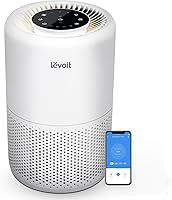
How can the Levoit Air Purifier for Home Pets Hair help?
The Levoit Air Purifier for Home Pets Hair has a 143 CFM CADR for smoke and is rated to refresh a 222 ft² room 4.8 times per hour. Its 3-stage original filter is HEPA-grade in Sleep Mode and has 99.97% filtration efficiency for 0.1 to 0.3μm airborne particulates.
The Core 300-P measures 8.7 in D x 8.7 in W x 14.2 in H and weighs 7.9 lb. Sleep Mode is rated at 24 dB, and the unit has a touch control, timer settings from 2 to 8 hours, and a check-filter indicator.
Levoit recommends official replacement filters and replacing them every 6 to 8 months. The unit uses 120V AC power and is intended for use in the United States.
Which purifier suits a larger smoke-affected room?
A larger room needs enough airflow to cycle its air repeatedly. If smoke spreads through an open living area, compare the purifier's stated coverage and smoke performance with the actual space rather than relying on a small-room rating.
The best air purifier for smoke roundup can help you compare options for general smoke control. If the problem is specifically tobacco smoke, see the best air purifier for cigarette smoke guide.
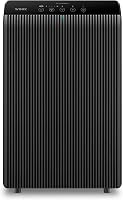
How can the COWAY Air Purifier for Home Up help?
The COWAY Air Purifier for Home Up is designed to clean spaces up to 1,748 ft² in 60 minutes. Its 4-stage system combines a washable pre-filter, deodorization filter, Bipolar Device, and HEPA filter.
The purifier reduces 99.97% of 0.3 micron particles, including pollen and other allergens, and its deodorization filter is intended to reduce volatile organic compounds and odor. An air-quality indicator shows changing indoor conditions, while Auto and Eco modes adjust operation.
The filter indicator signals when filters need replacement, and the pre-filter needs cleaning. The AP-1512HH(W) measures 9.6 x 16.8 x 18.3 in and weighs 12.5 lb.
Does a smoke purifier need to run all day?
Run the purifier during and after a smoke event when the room is occupied or recently polluted, following its instructions. Continuous operation may help maintain lower airborne particle levels, but it does not remove residue from surfaces.
A higher fan setting can move more air, while a lower setting may be easier to tolerate for longer periods. Keep doors and windows arranged so the purifier is not simply moving smoke into other rooms.
Replace or clean filters as directed. A loaded filter can restrict airflow, and a carbon stage can lose odor-control ability after extended smoke exposure.
How can the Medify MA-40 Air Purifier with HEPA Filter help?
The Medify MA-40 Air Purifier with HEPA Filter has a stated CADR of 406 and is designed to clean up to 1,793 ft² in 1 hour or 896 ft² in 30 minutes. Its HEPA H13 filter targets particles down to 0.1 microns.
The unit has 3 fan speeds, a touch panel, an 0 to 8-hour timer, sleep mode, a filter replacement indicator, and a child lock. Its stated noise range is 46 to 66 dB, and the included filter is a True HEPA H13 filter.
Medify Air says the replacement filter lasts about 6 months or 3,000 hours. The purifier uses 110V plug-in power and measures 25 in D x 24.5 in W x 13 in H according to the supplied specifications.
Can an air purifier remove cigarette smell from a room?
It may reduce airborne cigarette odor, but it cannot guarantee a smoke-free smell. Odor can remain in upholstery, carpet, clothing, curtains, walls, and other porous materials after the air has been filtered.
Use a carbon-equipped purifier alongside source control and surface cleaning. Wash or clean items that hold odor, ventilate outdoors when possible, and avoid masking smoke with fragrances.
For homes dealing with both tobacco smoke and animal dander, compare the best air purifier for smoke and pets. If dust is also a concern, the best air purifier for dust and smoke guide covers that combination.
What about cigarette smoke in a car?
A room purifier is not automatically the right choice for a vehicle. A car has a smaller enclosed space, different power needs, and upholstery that can hold smoke residue.
Clean the interior surfaces and use the vehicle's ventilation system as directed. If you are comparing a dedicated option, see the best air purifier for car smoke guide.
How should you use a purifier in a small room?
Choose a purifier that can cycle the small room several times per hour without blocking its intake or outlet. Place it where smoke is likely to collect, keep it away from walls and curtains, and use a higher setting during active pollution if the instructions allow it.
A smaller bedroom may not need the same airflow as an open living area. The best air purifiers for smoke in small rooms guide focuses on compact spaces and practical placement.
Do not place a purifier where smoke can be pulled directly from a flame or where heat, moisture, or spills could damage it. Follow the unit's safety instructions and keep cords away from pets and walkways.
Can an air purifier make indoor smoking safe?
No. An air purifier can reduce some airborne pollution, but it cannot make indoor smoking safe.
It does not remove every gas, particle, or residue, and it cannot protect everyone from exposure throughout a home.
The clearest decision rule is simple: stop smoking indoors first, then use a purifier to reduce remaining airborne particles and odors. Choose Levoit for a compact room, COWAY for automatic monitoring and larger stated coverage, or Medify for high stated CADR and large-room smoke filtration.
Frequently asked questions
Do air purifiers remove cigarette smoke?
Yes, air purifiers can remove many airborne cigarette smoke particles when they use efficient particle filtration and move enough air through the room. Activated carbon can also reduce some smoke gases and odors.
They cannot remove smoke residue from walls, furniture, clothing, or other surfaces.
Does an air purifier remove cigarette smell?
An air purifier may reduce cigarette smell, especially when it combines particle filtration with an activated carbon or deodorization filter. Odor removal depends on the amount of carbon, room size, airflow, and how much smoke is present.
Cleaning surfaces and stopping indoor smoking remain necessary.
Is HEPA enough for cigarette smoke?
HEPA filtration is useful for the fine particles in cigarette smoke, but it does not handle every gas or odor. A purifier with both a particle filter and an activated carbon stage is a better fit when smoke smell and gaseous pollutants are part of the problem.
Where should you place an air purifier for cigarette smoke?
Place the purifier in the room where smoke enters or builds up, with clear space around its intake and outlet. Keep doors and windows arranged to support ventilation, and avoid placing the unit behind furniture.
A purifier works on airborne pollution, not smoke residue already settled on surfaces.